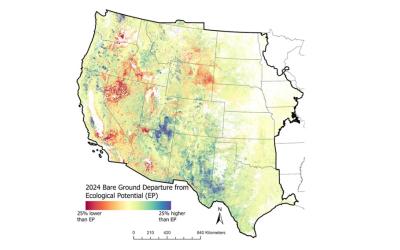
The Exotic Annual Grass (EAG) dataset provides early estimates of fractional cover of several EAG species and one native perennial grass species on a weekly basis during the core growing season of mid-April to late June. Typically, the EAG estimates are publicly released within 7-13 days of the latest satellite observation used for that version. Each weekly release contains five fractional cover maps along with their corresponding confidence maps for: 1) a group of 16 species of EAGs, 2) Cheatgrass (Bromus tectorum); 3) Combined cover of Field brome (Bromus arvensis) and Japanese brome (Bromus japonicus); 4) Medusahead (Taeniatherum caput-medusae); and 5) Sandberg bluegrass (Poa secunda). These datasets were generated leveraging field observations from Bureau of Land Management (BLM) Assessment, Inventory, and Monitoring (AIM) data plots; Harmonized Landsat and Sentinel-2 (HLS) based Normalized Difference Vegetation Index (NDVI); other relevant environmental, vegetation, remotely sensed, and geophysical drivers; and artificial intelligence/machine learning techniques. A total of 40,154 AIM plots from years 2016–2024 were used to train an ensemble of five-fold regression-tree models using a cross-validation approach (each observation was used as test data once and as training data four times) that developed all the fractional cover maps. The geographic coverage includes arid and semi-arid rangelands in the western U.S classified as shrubs or grassland/herbaceous by the 2023 Land Cover product from Annual National Land Cover Database (NLCD) CONUS Collection 1.0 at or below 2350-m elevation. A main objective of releasing these maps is to provide a tool for better monitoring EAG dynamics and informing conservation and management efforts at local to regional scales.
Preferred Citation:
Dahal, D., Boyte, S., Megard, L., Postma, K., and Pastick, N., 2025, Early Estimates of Exotic Annual Grass (EAG) in the Sagebrush Biome, USA, 2025 (ver. 10.0, June 2025): U.S. Geological Survey data release, https://doi.org/10.5066/P14VQEGO.
Related Citations:
Dahal, D., N. Pastick, S. Boyte, S. Parajuli, M. Oimoen, and L. Megard. 2022. Multi-Species Inference of Exotic Annual and Native Perennial Grasses in Rangelands of the Western United States Using Harmonized Landsat and Sentinel-2 Data. Remote Sensing 14: 807. https://doi.org/10.3390/rs14040807.
Pastick, N., B. Wylie, M. Rigge, D. Dahal, S. Boyte, M. Jones, B. Allred, S. Parajuli, and Z. Wu. 2021. Rapid Monitoring of the Abundance and Spread of Exotic Annual Grasses in the Western United States Using Remote Sensing and Machine Learning. AGU advances. https://dx.doi.org/10.1029/2020AV000298.
Pastick, N., D. Dahal, B. Wylie, S. Parajuli, S. Boyte, and Z. Wu. 2020. Characterizing Land Surface Phenology and Exotic Annual Grasses in Dryland Ecosystems Using Landsat and Sentinel-2 Data in Harmony. Remote Sensing 12: 725. https://dx.doi.org/10.3390/rs12040725.
Pastick, N., B. Wylie, and Z. Wu. 2018. Spatiotemporal Analysis of Landsat-8 and Sentinel-2 Data to Support Monitoring of Dryland Ecosystems. Remote Sensing 10: 5. https://dx.doi.org/doi:10.3390/rs10050791.