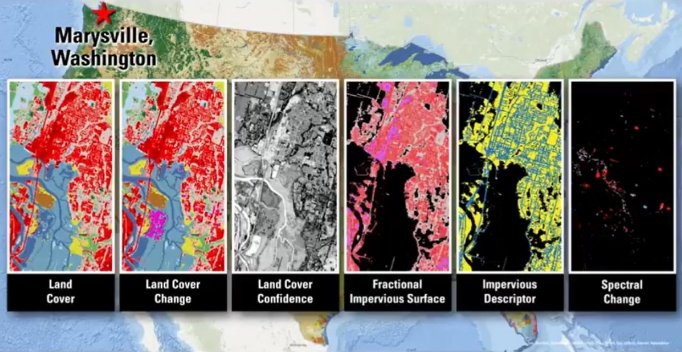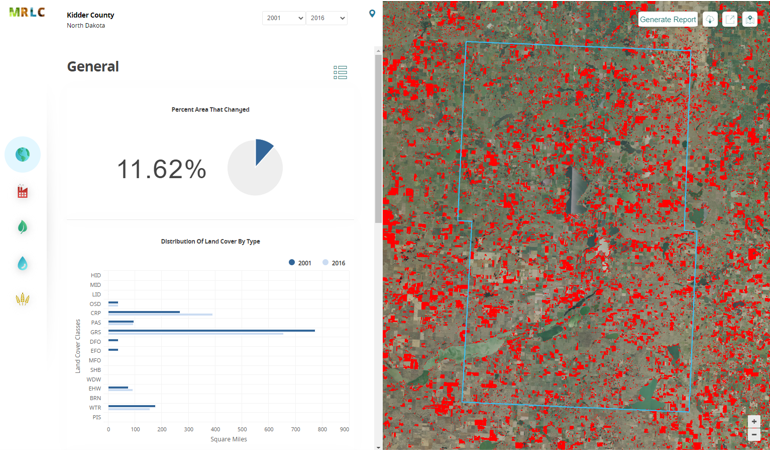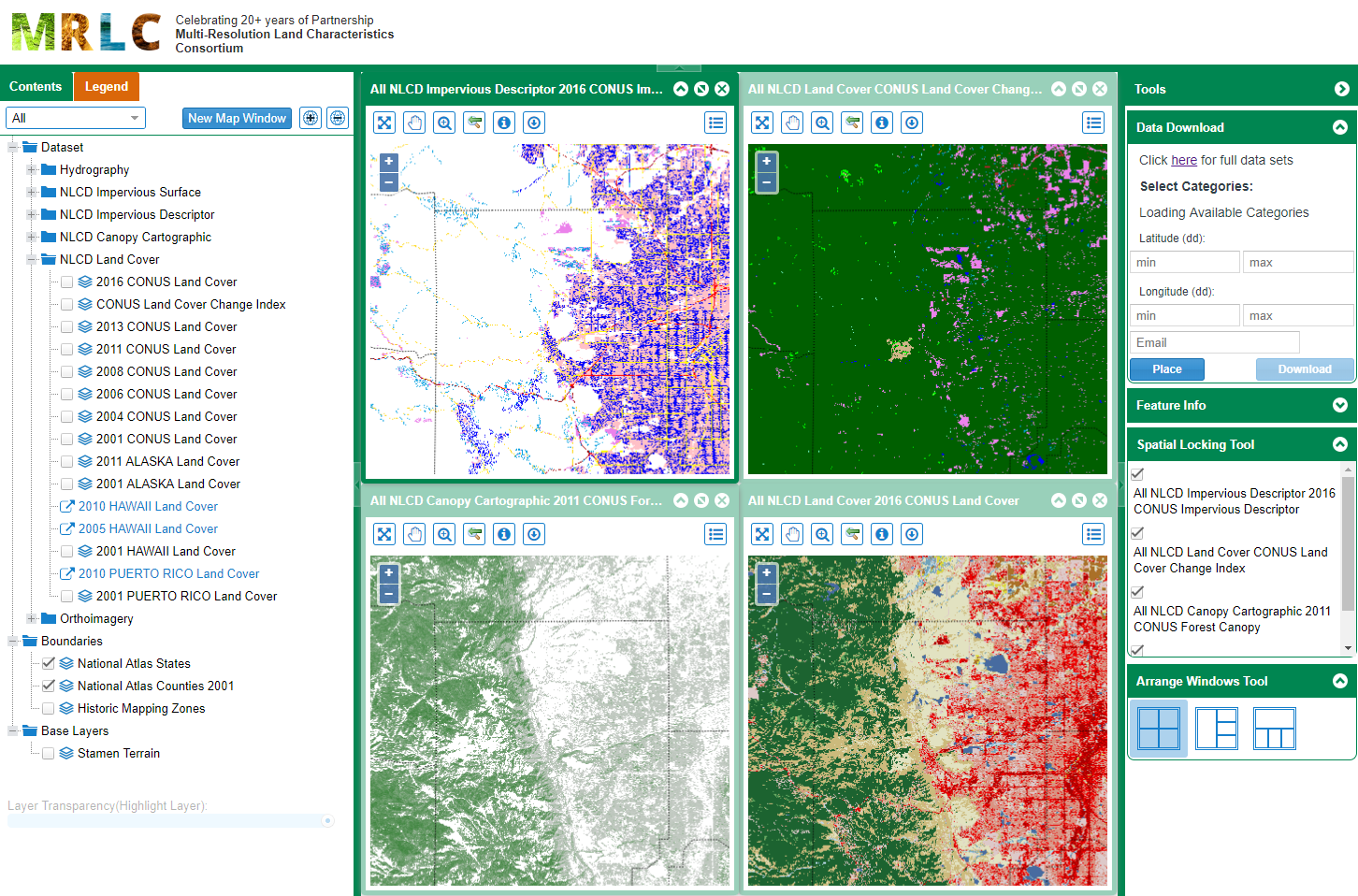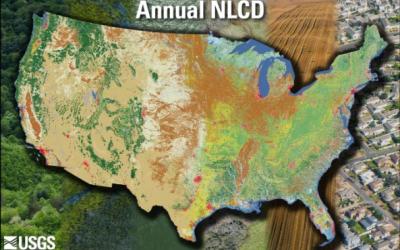










The U.S. Geological Survey (USGS)’s Land Cover program has leveraged methodologies from legacy land cover projects - National Land Cover Database (NLCD) and Land Change Monitoring, Assessment, and Projection (LCMAP) - together with modern innovations in geospatial deep learning technologies to create the next generation of land cover and land change information. The product suite is called, “Annual NLCD” and includes six annual products that represent land cover and surface change characteristics of the U.S.:
- Land Cover (LndCov): Depicts the predominant thematic land cover class within the mapping year with respect to broad categories of artificial or natural surface cover.
- Land Cover Change (LndChg): Depicts land cover change between one product year and the next. Changes are represented in the latter year.
- Land Cover Confidence (LndCnf): Depicts the probability value for the land cover class derived from the classification method.
- Fractional Impervious Surface (FctImp): Depicts the fractional surface area of the map unit (pixel) that is covered with artificial substrate or structures.
- Impervious Descriptor (ImpDsc): Depicts categorical data for developed land cover distinguishing roads from urban-non-road.
- Spectral Change Day of Year (SpcChg): Depicts the day-of-year (DOY) on which a significant deviation in Landsat surface reflectance was detected within the calendar year.

These land cover science algorithms harness the remotely sensed Landsat data record to provide the land surface change information needed by scientists, resource managers, and decision-makers. Annual NLCD uses a modernized, integrated approach to map, monitor, synthesize and understand the complexities of land use, cover and condition change. With this first release - Annual NLCD, Collection 1.0 - the six products mentioned above are available for the Conterminous U.S. for 1985 – 2023.